March 12, 2026 Ι Bloomberg CityLab
In the 1960s, America marshalled its massive breadth of military and civilian technological expertise for a mission that was deemed critical to the country’s national security and economic development. Generous government funding was directed to major corporations, including aerospace and defense industry mainstays, and to government labs, testing the limits of material science and industrialized construction. The effort was helmed by a rocket scientist with expertise in nuclear reactor propulsion.
The mission? It wasn’t to go to the moon. It was to keep people earthbound in a way that raised the quality of their life.
Operation Breakthrough, a moonshot by the US Department of Housing and Urban Development, was meant to radically reshape the housing industry to deliver shelter to a wider swath of Americans. The goal was to deploy modular and pre-fabrication industrialized construction methods with a progressive social mandate in order to produce tens of millions of new homes. Introduced in 1969 by HUD director George Romney and Harold Finger, a former top-level NASA administrator who joined HUD as its first assistant secretary of research and technology, the program is regarded as the most ambitious federal housing program in US history. It remains largely unknown.
In many ways, Operation Breakthrough extended mid-century confidence in hard-science research and development from the nerds at NASA to the housers at HUD. The program was called the “Cape Canaveral of the housing industry.” The enduring housing crisis today is a testament to the ways Operation Breakthrough failed to reach escape velocity.
Operation Breakthrough and the prototypes it produced are featured in an exhibit at the National Public Housing Museum in Chicago, curated by University of Illinois at Chicago architecture professor Alexander Eisenschmidt of the Housing Futures Initiative. Called “Breakthrough: Housing Futures,” the show includes floor-to-ceiling drawings and photographs of the program’s proposed building systems. A small library on housing design and policy mounted on a custom-designed moveable wall and shelf — furniture for an eventual model unit that Eisenschmidt is fundraising to build — is also filled with extensive Operation Breakthrough technical manuals, illustrating the rigor and ambition of the 1970s program.
Then as now, policy leaders were aghast at anemic housing production levels. In the prime of the Baby Boom, between 1950 and 1960, housing construction declined by 52% as a share of GNP, according to federal records. In an era of expanding material abundance made possible by ever more efficient widget production and mass-produced systems thinking, the building industry remained an idiosyncratic fragmented thing: thousands of builders working across thousands of towns and cities, the largest among them producing less than 1 or 2% of the total supply. Building and zoning codes resisted nationwide vertical integration, making economies of scale impossible.
The ambition was to use new technology to get homes rolling off factory lines fast enough to build 26 million homes in 10 years. This astonishing feat would cover rural, suburban and urban contexts. Homeownership was emphasized, as well as a variety of housing types: single-family homes, townhouses, small apartments buildings and high rises. By the mid-1960s, government intervention in the housing market had already gained a stigma as producing austere superblocks meant for those on the edge of destitution. But Operation Breakthrough sought to reshape a much wider swath of the market, focused on low- to middle-income people — not those on the brink of homelessness, says Kristin Szylvian, associate professor of history at St. John’s University, but rather “people that were on the margins of homeownership.”
Mission to Find Space
In a 1971 issue of HUD Challenge, an in-house publication, Finger compared his housing initiative directly to the defense and aerospace industry, beginning with a long-winded description of the scientific method. Hundreds of pages of documentation generated by Operation Breakthrough reveal stress tests and contingency planning fit for a mandate from Mission Control. There were fire tests, sealant logistics and plumbing diagnostics, but also more bespoke assessments with custom gear. Researchers made a “hail gun” to test roof strength in the event of icy missiles falling from the sky, according to Operation Breakthrough technical manuals that are included in the exhibit. It “shot out ice spheres of 1 ½ inch in diameter and weighing 0.92 oz at the exposed roofing surfaces at an angle of 90 degrees and a velocity of approximately 112 fps.”
After gathering proposals on more than 400 different building technologies, HUD deemed 22 prototype-ready. Nine pilot sites were prepared, from St. Louis and Seattle to Macon, Georgia, and Jersey City, New Jersey.
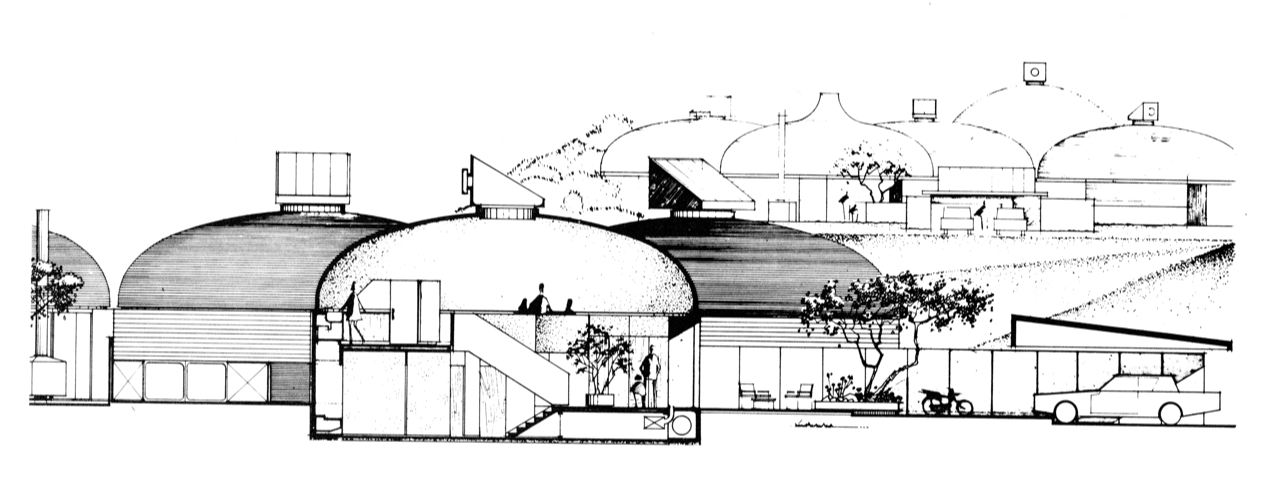
The most experimental proposals had an Apollo program aesthetic bordering on sci-fi to match their Greatest Generation confidence. A proposal from architecture firm SOM and Boeing envisioned something like spherical lunar modules touching down on spindly legs somewhere between Mars and Macon, their fiberglass shells only 1/16 of an inch thick. Another featured cranes slotting fully formed apartments into multistory superstructural frames; elsewhere pleated folds formed walls and roofs seemingly fit for Tatooine.
The teams proposing the new building systems often included architects, but this was largely a construction-technology-driven endeavor, with heavy input from established home builders and industrial giants like Dow Chemical, GE and US Steel — some of whom were directly adapting fiberglass aerospace technology for use in home construction.
But this public-facing presentation of otherworldly housing development wasn’t the whole story. Two-thirds of the technologies evaluated were essentially off-the-shelf products. Finger described his mission as “changing consumer attitudes about factory-produced housing,” and told a lecture audience in 1979 that relatively little of the program’s work was basic research. Its primary value was in scaling up this extant technology and “putting it all together,” says Szylvian, who is writing a book about Operation Breakthrough. Romney “was a good assembler of things.” With the thrill of a Space Race victory still tingling the American psyche, foregrounding the experimental research that did occur was a way to apply prestige and credibility to a domestic policy goal that would inevitably be politicized and negatively polarized.
Prototypes hewed toward the conventional, with composite panelized systems and some wood framing. Shelley Systems supplied a system of multistory off-set concrete pre-fab units that created small, sheltered terraces between the units. The Townland system was the most ambitious, addressing the concerns of urban renewal by creating new “urban land”: walkways and quasi-public spaces woven between multi-story apartment units, slotted in a structural frame where landscapes could be planted. With their tall structural frames, this housing could hover over urban fabric on the bulldozer’s itinerary, allowing residents to move directly out of their coldwater flats into new housing without being displaced.
In a video gallery at the National Public Housing Museum — which opened last year as the nation’s first cultural center devoted to the history of social housing — a 12-minute HUD promotional video on Operation Breakthrough exudes confidence that the government can solve a housing problem. From the perspective of the current affordability crisis, that certainty seems as far off as one of Finger’s rocket ships, blasting into space: “Operation Breakthrough has proven that government, through action and cooperation with private industry can solve the problems that face our growing nation before they reach the critical stage.”
The first housing secretary to serve after the Fair Housing Act of 1968, Romney linked poor housing and discrimination to urban unrest. “We have concluded that the number one thing that would really start us in a new direction in meeting the city’s problems is housing,” he said in 1969. His undersecretary, Richard Van Dusten, called for “flexibility” and “give” in the housing market. He tied slack housing development to racism and saw Operation Breakthrough as a way to promote racial integration. From the depths of the Nixon administration, Romney established a progressive mandate for HUD.
“Patterns of discrimination, largely racial, are a constraint to volume housing production,” Van Dusten said in 1969. “If you can reduce the overcrowding, you can reduce urban tension. If you build units that are attractive, in inner city and suburban locations, perhaps you can stop the exit of the affluent to the suburbs and the concentration of the poor in the ghetto and develop a more balanced community.”
Operation Breakthrough launched “building models for the post-Jim Crow landscape,” says Szylvian. The program supported cooperative housing developments, and required that minority-owned firms be hired to build them. This social mission is what she sees as the program’s greatest legacy.
Underpinning all this was Romney’s status as a political animal seemingly unrecognizable in the current menagerie: a liberal Republican. An auto executive and former governor of Michigan (and Mitt Romney’s father), he moralized against countercultural college students and welfare hand-outs, but also backed rent controls, was friendly with radical community-organizer Saul Alinsky and staunchly supported racial integration, warning of “the mounting danger of hostile confrontations between an achieving society and a dependent society — suburb against slum, prosperous vs. poor, white against black, brother against brother.” If Black and white people cannot live together, Romney said in 1969, we “will not have a country.”
The prototype developments in St. Louis and Kalamazoo really did become racially and economically diverse places. In Michigan, more than a quarter of residents were Black, and incomes ranged from $1,200 to $43,000 annually ($8,000 to $283,000 in today’s dollars). Problems quickly emerged, though, with complaints of high maintenance costs and leaky steel roofs that groaned as they expanded and contracted in the heat and cold. “The socialization is the one thing that worked,” one resident told the New York Times in 1974. “The site and the housing have failed.”
“Doomed From the Outset”
Operation Breakthrough administrators had to work hard to secure support from all sectors. Organized labor was a key pillar Romney felt he had to get onboard. Enticed by the prospect of less seasonal, indoor work in a factory, the UAW announced its support, but the AFL/CIO booed Romney when he unveiled the plan, fearing labor’s reduced role in a new mechanized regime. Local neighbors often responded with a sampler platter of NIMBY concerns about building more housing: too dense, too poor, loss of local control. To win residents over in Macon, HUD staff flew balloons from the proposed height of the mid-rise housing block to make sure it wouldn’t block views.
The several thousand prototype units built as part of Operation Breakthrough didn’t kickstart a revolution in homebuilding. The political shelf-life of advocating for residential integration at the dawn of the Southern Strategy was brief, and both Operation Breakthrough’s social and infrastructural development elements ran counter to the Nixon administrator’s policy to devolve federal programs and functions to the states. Romney was never an insider in the Nixon White House, and developed the program for more than a year without consulting his boss. Republicans in the House decried Operation Breakthrough as “socialistic,” “totalitarian” and “dastardly.” The program’s funding was slashed in its first two years, as lawmakers call it “gimmickry.” There was little stomach for absorbing the elevated prototype costs that came with deploying untested ways to build. “Nixon has said that the Federal Government cannot continue to stand ‘impassively at the cash register’ and pay for the high cost of housing,” intoned the New York Times in 1972.
“You could argue that Operation Breakthrough was doomed from the outset,” says Szylvian.
In the end, Operation Breakthrough was the dying dream of the New Deal coalition, striving to build what FDR envisioned as a key element of his proposed “second bill of rights”: the right to decent housing. Romney left HUD in 1973, and the program was “fizzled out intentionally,” says Eisenschmidt, denied funding and left for dead by 1976 with about 3,000 units of housing to its name. The federal consensus was that the government should not be in the business of experimental demonstration projects — and that if left to its own success, might have reshaped the housing market in ways that would be undesirable to incumbent interests, he says. “I feel like Congress realized it might just work.”
Flooding the market with 26 million homes aimed toward the bottom of the market would have radically reshaped who gets a path toward generational wealth. Yet in some ways the program was conservative. It was generally deregulatory, as local codes were waived at building sites; it subsidized private sector research and encouraged greater corporate consolidation within vertically integrated corporations that managed every element of home construction.
Stubbornly, modular construction does work elsewhere, thanks in part to American innovation. Japan sent a delegation to study Operation Breakthrough’s advances, and today, 15% of construction there is industrialized. In Sweden, it’s 45%, compared to the United States’ 3%. Land-use and building patterns in the US, with its historic wide-open frontier and surfeit of space, tend to place less of a premium on energy and transit efficiency, which allowed fragmented building industry incumbents to build up the power to resist consolidation.
Though the St. Louis site was razed and the Seattle site partially demolished, most Operation Breakthrough sites are still intact — lonely witness to the potential of modular construction to open up new paths to homeownership.
“Maybe it’s not prefabrication as a system that needs radical rethinking,” says Eisenschmidt. “Maybe incentives are structured and the economic system is structured that might be preventing progressive housing schemes from emerging.”